Understanding Vehicle Motion

Brake Testing with Dynamics Duo

Accurate entry speed, clean deceleration traces and repeatable MFDD results so braking performance meets regulatory requirements every time.

100 Hz output rate
±1.8 cm braking accuracy
0.1 km/h RMS Velocity accuracy

THE CHALLENGE

One weak measurement invalidates the run

Brake testing has no margin for measurement error. Speed, timing, deceleration and distance all need to be accurate, aligned and repeatable – every run, every time.

01

Entry speed outside the valid window

Brake tests require the vehicle to cross the trigger point within a tightly defined speed window. If entry speed is measured inaccurately – or drifts due to poor GPS – the run is invalid before braking even begins.

02

Trigger timing errors corrupt the result

MFDD and stopping distance calculations depend on knowing exactly when braking started. Any misalignment between the speed signal, deceleration trace and brake event shifts the entire measurement window and undermines the result.

03

Noisy deceleration traces

Calculating MFDD from noisy longitudinal acceleration data produces unreliable results. Sensor noise or vibration – particularly from roof-mounted GNSS antennas – distorts the deceleration profile and makes pass/fail thresholds hard to apply consistently.

04

Run-to-run variation that questions the measurement

When repeated runs produce different results under identical conditions, it is unclear whether vehicle behaviour changed or the measurement did. Without a stable, low-drift reference, variation between runs is hard to explain – whether for regulatory submission or internal development sign-off.

THE SYSTEM

Two instruments. One coherent measurement.

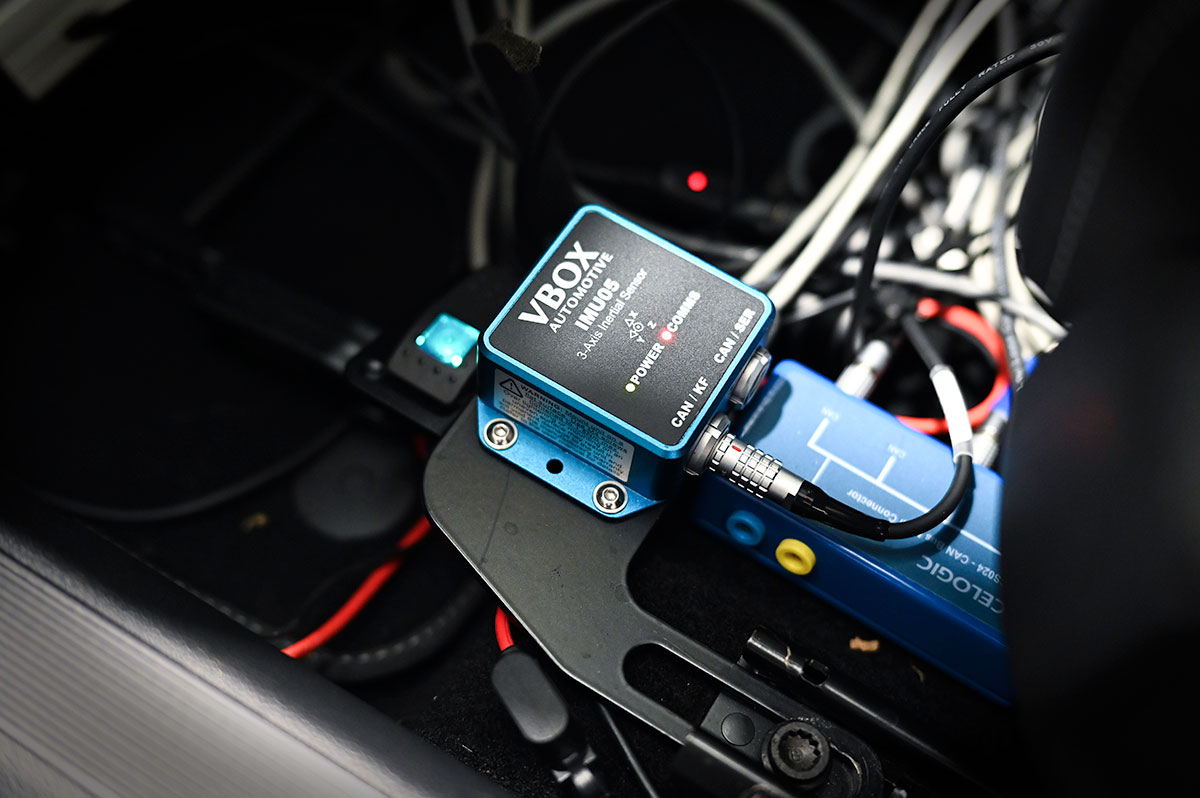
VBOX 4 provides high-accuracy speed, distance and deceleration. IMU05 adds low-noise inertial data referenced to the vehicle's centre of gravity. Together they give you a clean, aligned measurement of braking from trigger to standstill.
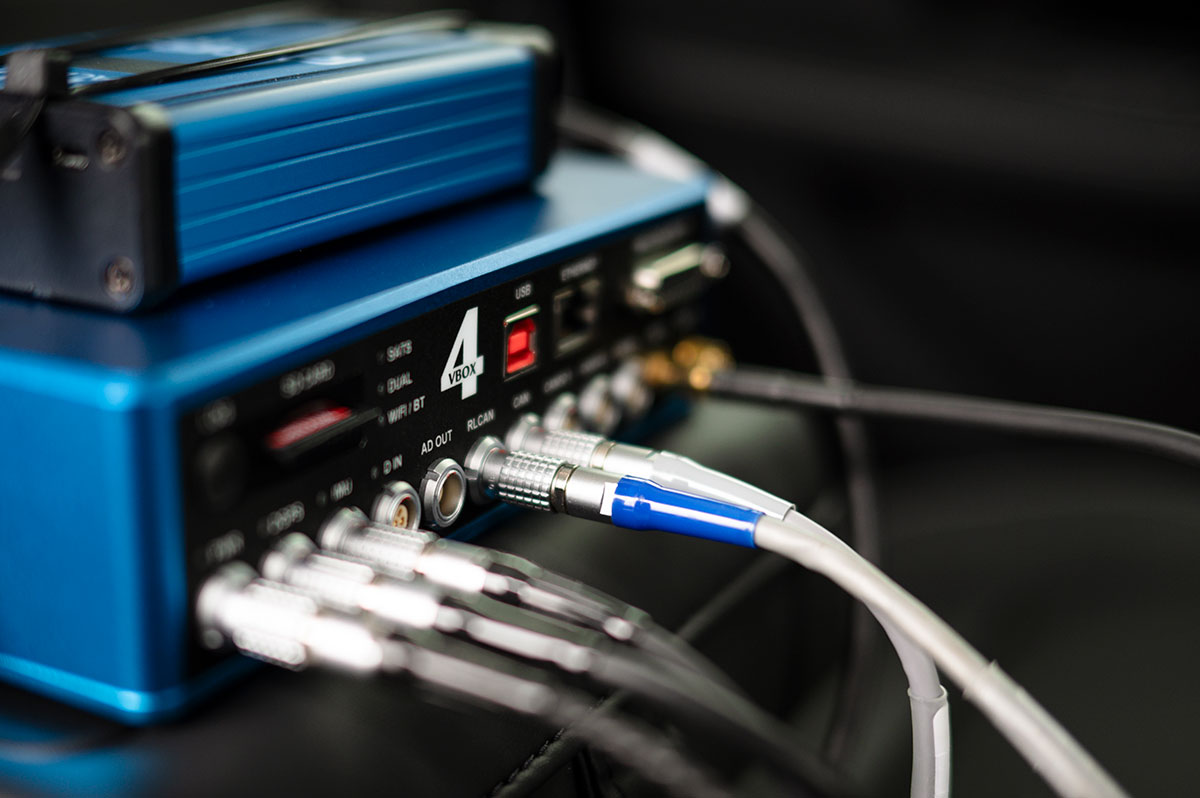
Speed, longitudinal acceleration and distance are merged on a single time base, giving a complete picture of the braking event from entry speed to standstill.

WHY DYNAMICS DUO

Four things engineers need. All resolved in one setup.

01 / 04

Accurate speed and distance, every run

A brake test result depends entirely on knowing the vehicle's speed at the trigger point and the distance from there to standstill. Both need to be accurate and traceable.

  • Velocity accuracy of 0.1 km/h RMS for reliable entry speed validation
  • Brake distance accuracy to ±1.8 cm for defensible stopping distance results
  • Speed referenced to the vehicle – not affected by wheel lock or slip
  • Distance resolution of 1 cm throughout the braking event
02 / 04

Clean deceleration data for reliable MFDD

Mean Fully Developed Deceleration is calculated from the longitudinal acceleration trace. Noise, vibration or sensor bias in that trace directly affects the result.

  • Low-noise longitudinal acceleration from the IMU05 at the vehicle CG
  • Lever-arm compensation removes roof-mounting errors from the deceleration trace
  • Clean Ax trace supports accurate MFDD calculation run after run
  • IMU bias stability ensures consistent results across a full test day
03 / 04

Precise event timing and signal alignment

MFDD and stopping distance calculations depend on all signals being on the same time base. Any misalignment between speed, deceleration and the brake event shifts the result.

  • Speed, Ax and CAN signals merged on a single time base in the VBOX 4
  • Optional brake trigger input captures the exact moment braking begins
  • Pedal force sensor (optional) records driver input alongside vehicle response
  • Real-time display confirms trigger alignment before the run is committed
04 / 04

One setup from development to sign-off

The same Dynamics Duo installation covers early development work and final regulatory submission — reducing setup variation and keeping results comparable across the programme.

  • ISOFIX mount for fast, repeatable installation across vehicle variants
  • Consistent CG-referenced measurement regardless of vehicle configuration
  • Compatible with UNECE R13-H, FMVSS 135 and ISO 21994 test requirements
  • Real-time pass/fail feedback reduces wasted runs on track

REGULATORY & INDUSTRY STANDARDS

Standards and test frameworks supported

Accurate speed, distance and deceleration data that meets the requirements of every major braking standard.

Standard Test type Measurement challenge How Dynamics Duo helps
UNECE R13-HPassenger Car Braking (Global) Stopping distance, MFDD, fade and recovery tests Accurate entry speed validation; clean Ax trace for MFDD calculation; precise distance measurement 0.1 km/h velocity accuracy and ±1.8 cm brake distance accuracy — speed and distance traceable to a single aligned reference
UNECE R13Heavy Vehicle Braking (Global) Stopping distance and deceleration — trucks, buses and trailers Consistent deceleration measurement across multiple axles and vehicle configurations; stable reference across vehicle changes CG-referenced longitudinal acceleration unaffected by vehicle configuration; consistent ISOFIX installation across variants
FMVSS 135Light Vehicle Brake Systems (US) Stopping distance, thermal fade, partial failure and parking brake tests Entry speed compliance within defined window; stopping distance measurement across multiple test conditions Real-time speed display confirms entry window compliance; ±1.8 cm distance accuracy across cold, hot and recovery stops
ISO 21994Passenger Car ABS Stopping Distance Straight-line ABS braking — open-loop test method Accurate stopping distance on surfaces where ABS activates; speed at ABS engagement; run-to-run consistency GNSS-based speed unaffected by wheel lock; distance resolution of 1 cm; low-noise Ax trace captures ABS modulation clearly
ECE R139Brake Assist Systems Category B BAS performance validation Precise pedal application timing and deceleration response must be captured on the same time base Pedal force (optional), speed and Ax time-aligned on a single reference — BAS activation and vehicle response clearly separated
SAE J2909Light Vehicle Dry Stopping Distance Dry surface stopping distance — trigger brake stops Consistent entry speed and trigger alignment across back-to-back runs on varying surface conditions Stable GNSS speed reference and optional brake trigger input provide repeatable, traceable stopping distance results
UNECE R13-HPassenger Car Braking (Global)
Test type
Stopping distance, MFDD, fade and recovery tests
Challenge
Accurate entry speed validation; clean Ax trace for MFDD calculation; precise distance measurement
How Dynamics Duo helps
0.1 km/h velocity accuracy and ±1.8 cm brake distance accuracy — speed and distance traceable to a single aligned reference
UNECE R13Heavy Vehicle Braking (Global)
Test type
Stopping distance and deceleration — trucks, buses and trailers
Challenge
Consistent deceleration measurement across multiple axles and vehicle configurations; stable reference across vehicle changes
How Dynamics Duo helps
CG-referenced longitudinal acceleration unaffected by vehicle configuration; consistent ISOFIX installation across variants
FMVSS 135Light Vehicle Brake Systems (US)
Test type
Stopping distance, thermal fade, partial failure and parking brake tests
Challenge
Entry speed compliance within defined window; stopping distance measurement across multiple test conditions
How Dynamics Duo helps
Real-time speed display confirms entry window compliance; ±1.8 cm distance accuracy across cold, hot and recovery stops
ISO 21994Passenger Car ABS Stopping Distance
Test type
Straight-line ABS braking - open-loop test method
Challenge
Accurate stopping distance on surfaces where ABS activates; speed at ABS engagement; run-to-run consistency
How Dynamics Duo helps
GNSS-based speed unaffected by wheel lock; distance resolution of 1 cm; low-noise Ax trace captures ABS modulation clearly
ECE R139Brake Assist Systems
Test type
Category B BAS performance validation
Challenge
Precise pedal application timing and deceleration response must be captured on the same time base
How Dynamics Duo helps
Pedal force (optional), speed and Ax time-aligned on a single reference - BAS activation and vehicle response clearly separated
SAE J2909Light Vehicle Dry Stopping Distance
Test type
Dry surface stopping distance — trigger brake stops
Challenge
Consistent entry speed and trigger alignment across back-to-back runs on varying surface conditions
How Dynamics Duo helps
Stable GNSS speed reference and optional brake trigger input provide repeatable, traceable stopping distance results

WHAT YOU CAN MEASURE

Objective, reproducible parameters for brake testing

The parameters below are direct outputs of the VBOX 4 + IMU05 combination unless noted. All are logged, time-aligned and available for real-time display and post-test analysis.

Speed & distance

  • Vehicle speed (GNSS-referenced)
  • Entry speed at trigger point
  • Stopping distance
  • Distance resolution to 1 cm

Speed is unaffected by wheel lock or slip — GNSS-based measurement reflects true vehicle motion.

Deceleration & MFDD

  • Longitudinal acceleration (Ax) at the CG
  • Mean Fully Developed Deceleration (MFDD)
  • Time to stop
  • Deceleration profile throughout the event

Lever-arm compensation removes roof-mounting errors from the Ax trace — MFDD is calculated from clean, CG-referenced data.

Brake event & timing

  • Brake trigger timing (optional input)
  • Pedal force (optional sensor)
  • ABS activation and wheel speeds (via CAN)
  • Brake pressure and channel status (via CAN)

Vehicle behaviour under braking

  • Pitch angle during deceleration
  • Yaw rate and lateral acceleration
  • Vehicle path and trajectory
  • Left vs right deceleration comparison (split-µ)

Yaw and lateral data are available for split-µ and stability analysis — see the ESC & Handling page for full dynamics testing capability.

SOFTWARE & ANALYSIS

VBOX Test Suite – from trackside display to post-test analysis

VBOX Test Suite supports your entire test workflow – from live track-side monitoring through to regulatory submission – all within a single platform. Engineers can compare runs, overlay channels from identical test conditions, and export to downstream tools without conversion.

  • Real-time entry speed monitoring with pass/fail window validation
  • Deceleration trace overlay for run-to-run MFDD comparison
  • Multi-run overlay with channel alignment – compare back-to-back or vehicle-to-vehicle
  • Customisable workspace combining charts, maps, and synchronised HD video
  • Automated report generation for regulatory submissions

Data export formats

All VBOX data can be exported for use in other analysis tools such as MATLAB and Python.

.vbbNative VBOX format
.csv Excel & Python compatible
.matMATLAB / Python compatible
.txtTab-delimited text

VBOX CAN output is available for real-time integration with external data acquisition systems.

Ready to discuss your brake testing programme?

Our engineers understand the demands of regulatory brake testing. Contact us to discuss your specific test requirements, vehicle types and preferred standards.