Understanding Vehicle Motion
ESC Validation & Handling Analysis with Dynamics Duo
The VBOX 4 and IMU05 combine to deliver CG-referenced, time-aligned measurement of vehicle motion – built for ESC calibration, handling balance work, and regulatory compliance testing.
THE CHALLENGE
Why ESC and handling tests are hard to measure accurately
Fast manoeuvres, system interventions, and poor sensor placement combine to make cause-and-effect ambiguous. These are the problems Dynamics Duo is designed to resolve.
Signals that don't share a reference
Inertial data biased by mounting position
An IMU mounted at roof height exaggerates roll and introduces lever-arm errors in yaw and lateral acceleration. During aggressive manoeuvres, this compounds into significant measurement error at the frequency of interest.
Noise that obscures stability margins
Subtle changes in handling balance – understeer gradient shifts, yaw rate gain variation – are easily masked by sensor noise when data quality is marginal. ESC tuning decisions made on noisy data carry risk.
Separating driver action from system response
During ESC activation events, understanding whether the vehicle's behaviour was caused by the driver or the stability system requires simultaneous, synchronised capture of both. Any gap in the data creates ambiguity.
THE SYSTEM
Two instruments. One coherent measurement.
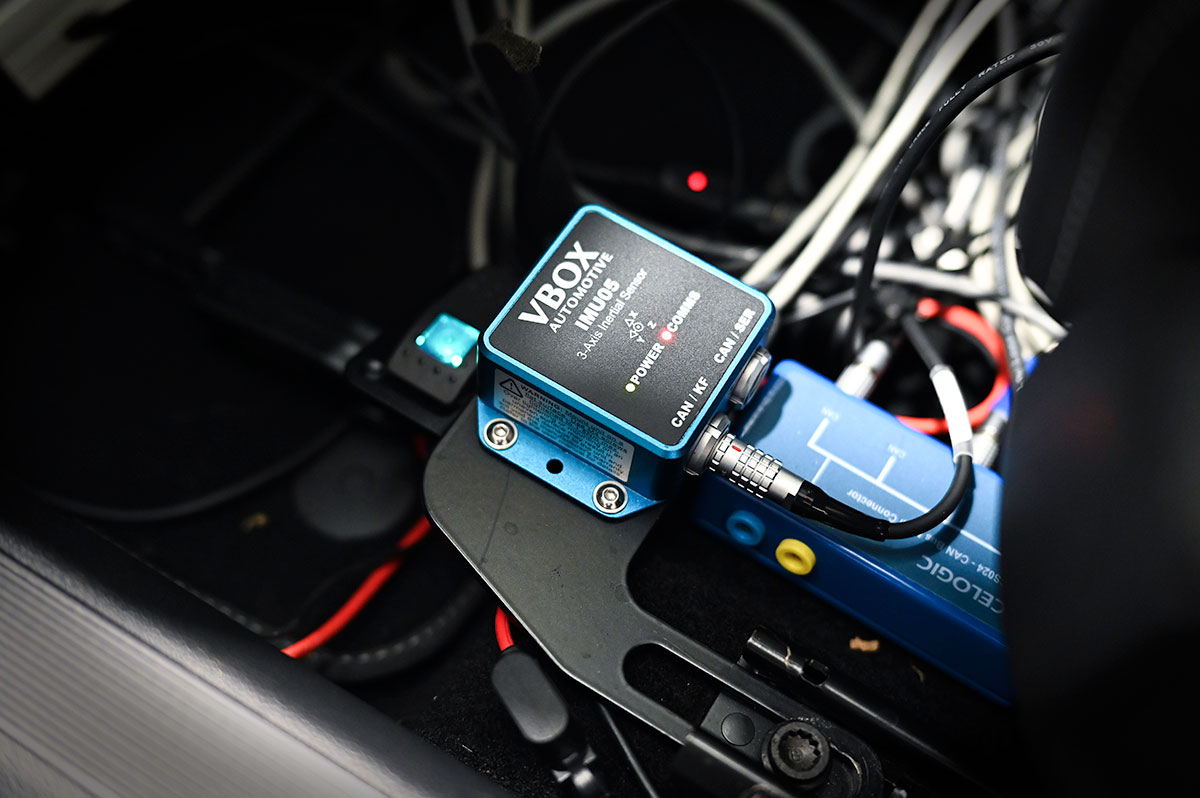
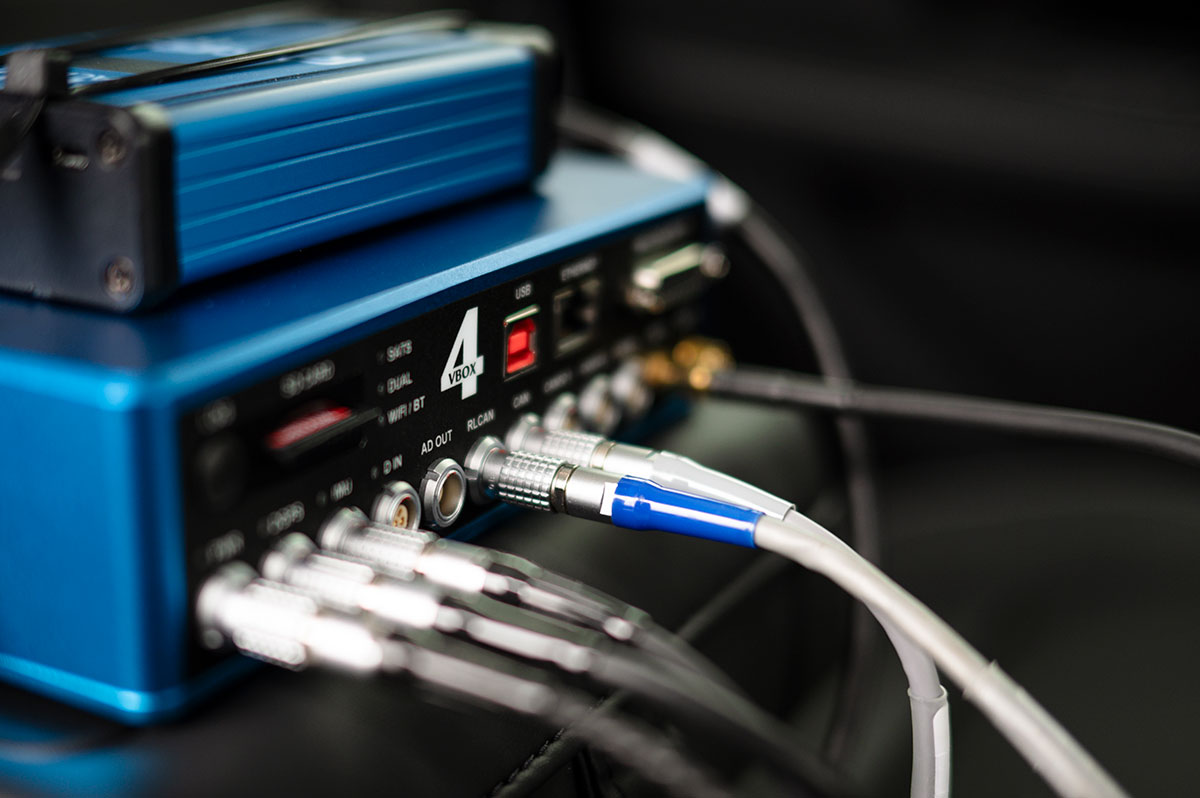
VBOX 4 provides high-accuracy GNSS-based speed, position and trajectory. IMU05 adds low-noise inertial data at the CG. Together they produce a single unified picture of vehicle motion.
Why Dynamics Duo

Accurate Inputs. True Vehicle Behaviour
For handling analysis, measurements must reflect how the vehicle moves at the true centre of gravity.
Dynamics Duo provides:
- Speed referenced to the centre of gravity, unaffected by wheel slip
- Yaw rate and lateral acceleration calculated at the CG
- Accurate vehicle trajectory for path assessment
- Longitudinal acceleration (Ax) to understand braking or lift-off during intervention
This keeps stability analysis tied to the true motion of the vehicle.

Clean Data. More Reliable Analysis
During fast manoeuvres, noisy or biased data makes behaviour hard to interpret.
With low-noise inertial data:
- Pitch and roll are measured during rapid steering inputs
- Yaw rate and lateral acceleration remain stable in aggressive events
- Vehicle rotation is measured without roof-mounted exaggeration
This means conclusions about stability and ESC performance are based on clear, reliable signals.

Clearly Separate Driver and ESC Actions
To tune ESC, you need to know what the driver did and what the system did.
The Dynamics Duo lets you:
- Log steering angle alongside yaw rate
- Compare wheel speeds with vehicle rotation
- Record ESC status and brake signals via CAN
This makes it easier to see whether behaviour comes from driver input or system intervention.

One Reliable Setup for ESC & Handling Testing
From ISO lane change tests to sine-with-dwell and steady-state manoeuvres:
- One installation supports multiple test types
- Alignment is quick, even across vehicle changes
- Real-time feedback confirms that the run is valid
Measure motion once and use it across the full stability programme.
POST-TEST ANALYSIS
VBOX Test Suite –analysis built for dynamics work
After testing, all logged data opens directly in VBOX Test Suite. Engineers can compare runs, overlay channels from identical test conditions, and export to downstream tools without conversion.
REGULATORY & INDUSTRY STANDARDS
Standards and test frameworks supported
Dynamics Duo provides the measurements needed to assess response, stability, and intervention behaviour across a broad range of regulatory and OEM test requirements.
| Standard | Manoeuvre | Measurement challenge | How Dynamics Duo helps |
|---|---|---|---|
|
UNECE R140
ESC Regulation
(Global) |
Sine with dwell, laned change on low-μ | Separating driver input from ESC action; yaw response timing under intervention | CG-referenced yaw, slip and lateral acceleration — time-aligned with CAN ESC status to clarify cause and effect |
|
FMVSS 126
US Federal Standard
|
Sine with dwell (1 Hz, 0.5 Hz variants) | Steering–yaw phase lag; noisy yaw in high-frequency transients | Low-lag yaw and slip on one time base — accurate intervention timing measurement and stability threshold assessment |
|
ISO 3888-2
Double Lane Change
|
Double lane change (elk test) | Path corridor compliance within tight tolerances; roof-biased motion during transients | Continuous CG-true trajectory and yaw for corridor analysis RTK recommended for cm-level path accuracy |
|
ISO 3888-1
Obstacle Avoidance
|
Obstacle avoidance lane change | Speed-dependent path deviation; yaw overshoot after course exit | Slip angle and yaw time-history through the event; trajectory vs cone corridor overlay |
|
ISO 4138
Steady-State Circular
|
Constant radius / constant speed sweep | Noise masks subtle changes in understeer gradient; CG vs wheel measurement discrepancy | Low-noise yaw rate gain and lateral acceleration at the CG — resolves handling balance changes with speed or load |
|
ISO 7401
Transient Response
|
Step steer, ramp steer, sinusoidal steer | Delayed or noisy signals obscure rise time and overshoot measurement | Time-aligned steering (via CAN), yaw and slip with low lag — accurate response time and yaw rate gain at frequency |
|
ISO 11026
High-Speed Sinusoidal Steer
|
Sine sweep (frequency ramp) | Lateral acceleration and yaw rate amplitude accuracy at 1–2 Hz; phase measurement | High sample rate GNSS-IMU fusion maintains accuracy through the frequency range of interest for frequency response analysis |
|
OEM ESC Protocols
Internal / Benchmarking
|
Manufacturer-specific calibration sequences | Inconsistent reference points when comparing variants or competitor vehicles | A single CG-referenced motion reference across all vehicles simplifies variant-to-variant and competitor benchmarking |
What Engineers Can Measure
The Dynamics Duo delivers the measurements required to assess performance, stability and vehicle behaviour using objective, reproducible parameters.
Steering & Vehicle Response
Vehicle response to driver input:
- Steering angle vs yaw rate
- How quickly the vehicle starts to rotate
- Yaw rate gain as speed increases
- Understeer / oversteer behaviour
Slip & Vehicle Balance
Understand how the vehicle rotates and holds the corner:
- Body slip angle at the centre of gravity (CG)
- Front vs rear slip comparison
- Lateral acceleration at the CG
- Handling balance changes with speed or surface
Path & Lane Change
Confirm the vehicle follows the intended line:
- Trajectory through the manoeuvre
- ISO 3888-2 corridor compliance
- Speed and distance throughout the test
Stability & ESC Behaviour
Assess how stability systems influence the vehicle:
- ESC activation timing (via CAN)
- Yaw change after ESC intervention
- Slip and lateral acceleration response
Fast manoeuvres
Analyse rapid changes in vehicle motion:
- Yaw build-up and settling time
- Roll and pitch during sharp inputs
- Left versus right comparison
- Run-to-run repeatability
Installation and operation
A simple installation of the IMU at Centre of Gravity and VBOX 4 secured on the ISOFIX mount allows for fast alignment and quick vehicle swaps. Real-time display confirms runs on track through multiple data streams so no time on track is wasted
Data You Can Tune From
ESC calibration and handling development depend on understanding what the vehicle was actually doing – not what a noisy or misreferenced sensor suggested.
The Dynamics Duo provides a single, CG-referenced motion record that separates driver input from system response, run after run. Engineers can work within established FMVSS 126, UNECE R13-H and ISO test frameworks, with confidence that results are consistent, defensible and ready for calibration sign-off, competitor benchmarking or development comparison.
Ready to move from measurement to confidence?
Contact us! We'll recommend the right Dynamics Duo configuration for your ESC and handling programme.